Spend a full workday on a construction site, a roofing job, a landscaping crew, a road project, a utility site, or a farm, and your skin takes a beating. The reason is exposure. Hour after hour, your skin meets sun, heat, sweat, wind, dust, and grit. Then you clock out, sleep, and do it again tomorrow.
So here is a fair question. If an outdoor worker started a sensible routine and stuck with it for 90 days, what would really change? Would the skin look different? Could old sun damage turn around? And what changes happen that you cannot see in the mirror?
The short answer –
Some wins come fast. Others take months or years. And one of the biggest wins is prevention: every day you protect your skin, you cut the new damage it takes on.
Why a Job Site Is Tough on Your Skin
For outdoor workers, the sun is more than a beach problem. It is a workplace exposure. NIOSH warns that working outside raises your UV exposure and the risks that come with it, including sunburn and skin cancer. UV rays reach your skin even on cloudy days.
Job-site conditions add a second problem. Wind, humidity, sweat, and sloppy application all lower how well sunscreen performs. One 6:30 a.m. application will not carry you through an eight-hour shift in the heat.
UV also drives how your skin ages. The Skin Cancer Foundation says the sun causes up to 90% of the visible changes we usually blame on getting older. UVA rays sink deeper and harm the connective tissue that keeps skin firm. UVB rays burn the surface. Both raise skin-cancer risk. Over years, repeated exposure adds up to:
- wrinkles
- rough texture
- uneven tone
- dark spots
- loss of firmness
- other visible signs of sun aging
That is why job-site skincare does far more than make your face look good. It supports your skin barrier today while trimming the extra UV that shapes your skin years from now.
Day 1: Set the Baseline
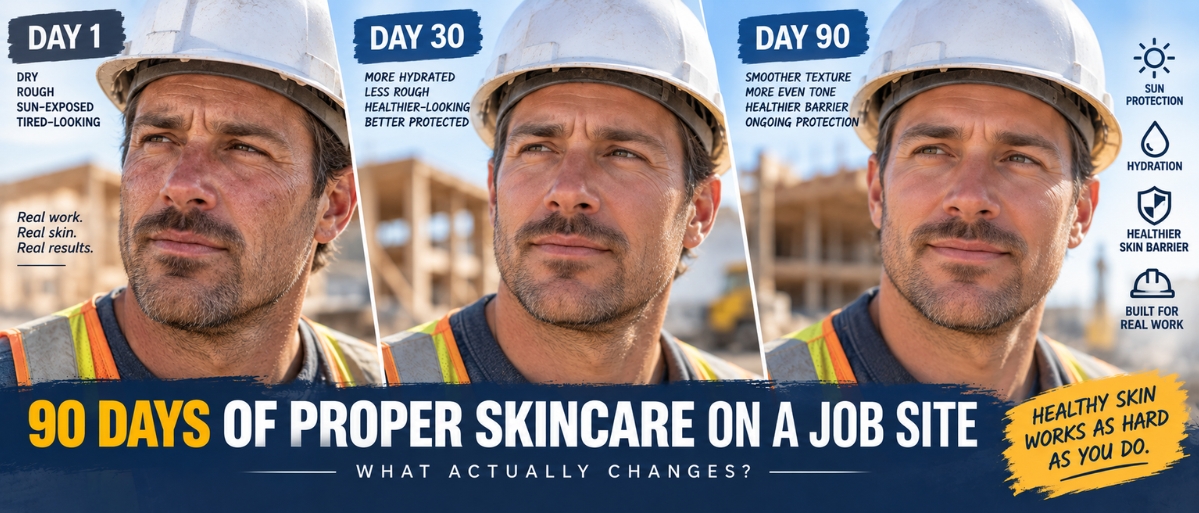
Picture a worker who has spent years outside and has skipped skincare. His face does not need to be covered in grime. The honest starting point is skin that looks and feels weathered: dry, rough, tight after washing, and uneven in tone. There may be freckles, dark spots, and fine lines from years of sun.
That is Day 1. And here is the honest promise up front. Ninety days will not erase years of sun. Ninety days is plenty of time to change the direction your skin is heading.
Days 1 to 7: Hydration Is the First Thing You Notice
The first win is not wrinkles. It is water. A good moisturizer raises the water content of your outer skin and slows the water that escapes through the barrier. Controlled studies show measurable gains in hydration and in transepidermal water loss, the amount of water leaking out through your skin.
In one study of people with dry skin, a single use of a ceramide moisturizer produced measurable hydration and barrier effects, with more improvement after 28 days of daily use. Results vary from person to person. The pattern holds: hydration changes much faster than sun aging.
In week one, your skin simply feels less tight, less dry, softer, and more comfortable. It is a quiet start, and it is the start of healthier skin.
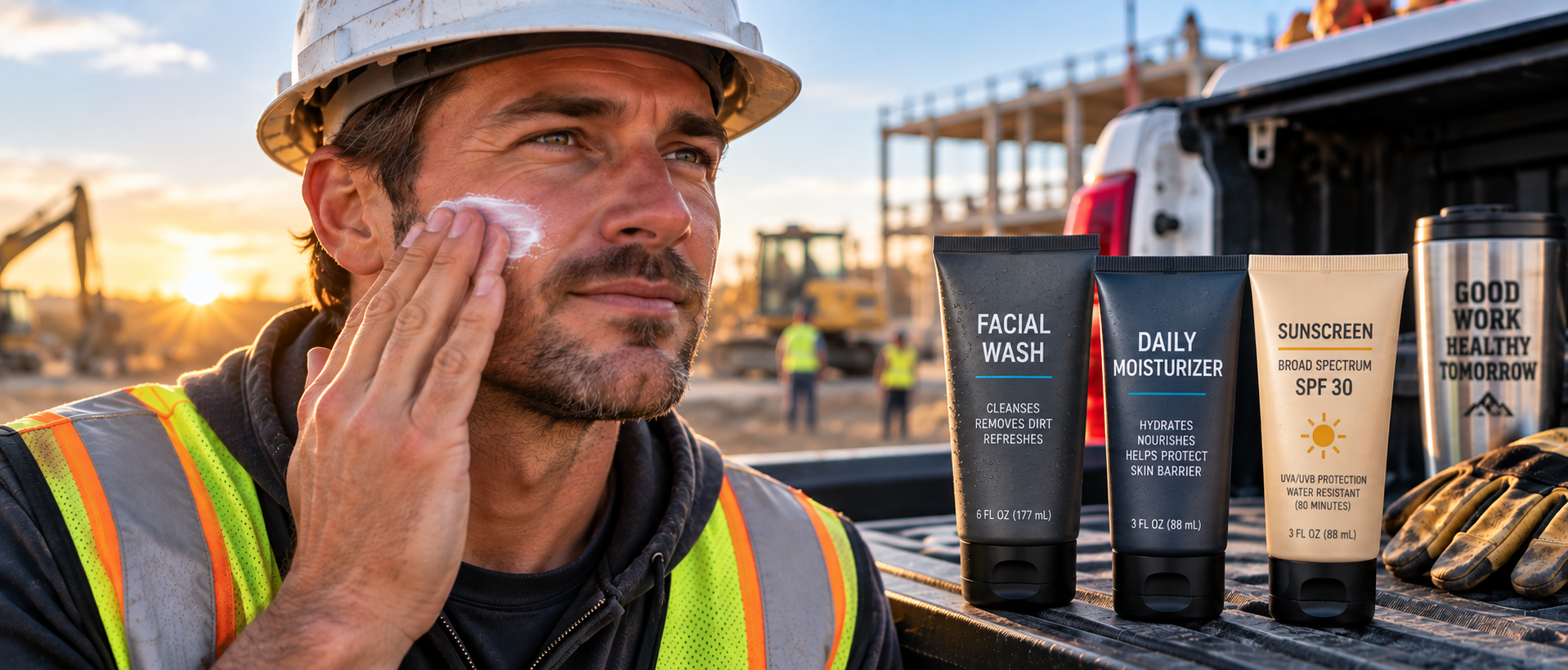
Days 7 to 30: Consistency Starts Paying Off
By now the routine repeats every day. Cleanse. Moisturize. Protect. Repeat. Studies of people with dry or stressed skin show measurable gains in hydration, dryness, and water loss after about four weeks of steady moisturizer use. Barrier support builds up over time.
Around Day 30, someone who started rough and dry may notice:
- better hydration
- less roughness
- less tightness after washing
- smoother-feeling skin
- less flaking
- a healthier look overall
You will feel the difference every day you live in that skin, long before anyone else spots it.
The Biggest Change Started on Day 1
While moisturizer makes your skin feel better, something bigger has been happening every morning. You started shielding your skin from UV rays. For a worker who spends the day outside, this is the most valuable change in the whole routine.
The AAD recommends a broad-spectrum, water-resistant sunscreen with SPF 30 or higher for exposed skin. Broad spectrum means it guards against both UVA and UVB. An SPF 30 sunscreen blocks about 97% of UVB rays. Treat sunscreen as one strong part of a bigger plan, and pair it with:
- protective clothing and UPF-rated fabrics
- UV-blocking sunglasses
- shade during breaks
- head and neck cover that works with your required safety gear
Workplace safety rules and required PPE always come first.
The Job-Site Sunscreen Problem
This is where ordinary advice falls apart. You apply sunscreen at 6:30 a.m. You drive to the site. You work. You sweat. You wipe your face. Dust sticks. Lunch comes and goes. At 2:00 p.m. you are still outside. That early-morning layer will not protect you the same way all shift.
The AAD says to reapply about every two hours outdoors, or after swimming or sweating, following the label. The National Institute for Occupational Safety and Health (NIOSH) gives the same guidance: reapply at least every two hours and after heavy sweating. So build your sun protection around the workday, not the bathroom mirror.
Make reapplication automatic
Keep sunscreen where you will actually use it: your work bag, lunchbox, locker, or truck (store it out of extreme heat and follow the label). Then tie reapplication to things that already happen: before work, mid-morning break, lunch, and again in the afternoon as needed.
Days 30 to 60: The Most Important Win May Be Invisible
By Day 30 or 60 you may be hunting for visible change. Separate two ideas here: how your skin looks, and how well your skin is protected.
Picture two workers on the same site, same hours, same sun. Worker A uses sunscreen once in a while, mostly on the hottest days. Worker B uses broad-spectrum SPF 30+ every day, reapplies on schedule, and adds UPF clothing and shade.
After 60 days their faces might look about the same. Their exposure histories look very different. Worker B spent two months cutting extra UV rays. Because sun aging piles up over time, that gap matters. Treat sunscreen as exposure control. Every layer lowers the UV your skin takes on today, which lowers the aging and the cancer risk that build over years.
Days 60 to 90: Visible Change Gets More Likely
Now you are near three months, where the 90-day mark gets interesting. In one study, 32 people put a broad-spectrum SPF 30 sunscreen on their faces every day for a year. Dermatologists graded their skin at the start and at Weeks 12, 24, 36, and 52. Every measured sun-aging score improved as early as Week 12, and kept improving through the year. Texture, clarity, and pigmentation improved the most, gaining 40% to 52% from the start by the one-year mark.
That study was small and had no untreated comparison group, so read it with care. It still points to something useful. Once you protect skin from ongoing UV rays, existing sun-damaged skin can start to look better too.
So around Day 90, depending on where you started and how steady you were, realistic wins include:
- better hydration
- less dryness
- smoother texture
- less roughness
- clearer-looking skin
- a healthier complexion overall
One thing stays off that list: looking ten years younger. That is on purpose.
What About Wrinkles?
This one needs care. Moisturizer can make fine lines look softer for now, because hydrated skin looks plumper and smoother. Improving set-in sun lines is a bigger job. Retinoids are among the best-studied ingredients for sun-aged skin. Controlled 12-week studies of retinol and tretinoin show gains in fine lines, wrinkles, tone, roughness, and overall sun damage. So 90 days can be long enough to see early change from a well-chosen active.
Here is the catch worth respecting. Skin that already meets sun, heat, sweat, wind, and repeated washing will not thank you for piling on retinol plus an acid plus a scrub plus a vitamin C all at once. Comfort is the sign you want. Redness and stinging mean ease off. Build the base first. Add one targeted treatment at a time, and give it room to work.
A Realistic Job-Site Routine (and What to Reach For)
The best routine is the one that survives contact with a full workday. For most people the base stays simple.
Morning
- Cleanse. Start with a gentle wash so your skin feels fresh without that stripped, tight feeling. MKMen® Daily Facial Wash clears oil and residue, suits sensitive skin, and is gentle enough for twice-daily use.
- Hydrate. MKMen® Ultimate Moisturizer with hydration that lasts over 10 hours.
- Protect. Mary Kay® Mineral Facial Sunscreen Broad Spectrum SPF 30 or Mary Kay® Sunscreen Broad Spectrum SPF 50. Remember to cover the spots many people miss: ears, neck, exposed scalp, and the backs of your hands.*
* Alternatively, reach for TimeWise® Daytime Defender Sunscreen Broad Spectrum SPF 30.
During the Workday (the part that matters most)
Reapply about every two hours outdoors and after heavy sweating, following instructions on the label. For a sweaty, all-day site, keep a water-resistant sunscreen on hand for the reapply step. Mary Kay® Sunscreen Broad Spectrum SPF 50 stays water-resistant for 80 minutes, wears light with no white cast, and covers face and body, so one bottle protects your face, neck, arms, and hands. It carries the Good Housekeeping Seal.
Round it out with UPF clothing, UV sunglasses, and shade on breaks. A hard hat is essential PPE, and it still leaves your face, ears, and neck open to the sun, so cover those too. Safety gear comes first, always.
After Work
- Cleanse. Wash off sunscreen, sweat, and job-site residue with MKMen® Daily Facial Wash. Skip the hard scrubbing, which only irritates dry skin.
- Treat, once your base is steady. When your skin is calm and used to the routine, add one targeted product at night. Mary Kay Clinical Solutions® Barrier Restore 1:1:3 helps strengthen and reinforce your skin barrier. On the other hand, Mary Kay® Retinol 0.3 helps smooth lines and even tone over time. (Keep retinol to one product a night, and pause retinol during pregnancy.)
- Moisturize. Seal it in with MKMen® Ultimate Moisturizer, which locks in hydration for 12 hours when used twice daily and helps defend against daily stressors.
Want the simplest start? The MKMen® Regimen bundles the daily wash, a shave cream, and the moisturizer in one set, so the base routine is ready to go on Day 1.

Day 1 vs. Day 30 vs. Day 90
| Time | What Is Happening | What You Might Notice |
|---|---|---|
| Day 1 | Setting the baseline | Dryness, roughness, and existing sun-related changes |
| Week 1 | Hydration begins improving | Skin feels softer, less tight, more comfortable |
| Day 30 | Steady barrier support | Less dryness and roughness, better hydration |
| Day 60 | Skincare plus daily UV protection | Skin looks healthier, and cutting extra UV rays becomes a real benefit |
| Day 90 | About 12 weeks of consistency | More likely gains in hydration, texture, clarity, and some visible sun-aging change |
This is a framework, not a fixed schedule. Your results depend on age, skin type, past sun, climate, products, and how steady you stay.
Keep Your Expectations Honest
Three months of skincare cannot undo 10 or 20 years of sun on the job. Deep lines and old dark spots need more time, and some respond best with a dermatologist’s help. Skin-cancer risk stays real, which is exactly why daily protection earns its place. Sunscreen works going forward: used correctly as part of a full sun-protection plan, it lowers the new UV rays your skin takes on.
What Happens If You Keep Going Past 90 Days?
Here the evidence gets strong. A randomized trial followed 903 adults for about 4.5 years. The group assigned to daily sunscreen showed 24% less skin aging than the group who used it at their own discretion. The daily group showed no detectable rise in skin aging over the whole study.
That is a much bigger idea than looking better after three months. Your daily habits can steer how your skin ages over years. Ninety days is not the finish line. It is enough time to lock in the habit.
Your Skin Is Equipment You Cannot Replace
Think about how you treat your tools. You maintain them. You clean them. You protect them. You service them before they fail. Give your skin the same respect, with one key difference. You can replace a drill, a saw, or a truck. You get one set of skin, and you will need it long after today’s job wraps.
One More Thing: Watch for Changes
Years of outdoor work mean you should keep an eye on how your skin changes over time. A new or changing growth, a sore that will not heal, a spot that keeps bleeding, or a mole that worries you deserves a doctor’s eyes. Skincare is maintenance. It works alongside medical care and skin-cancer screening, and it stands in for neither.
The Bottom Line
You do not need a ten-step routine to change your skin on a job site. Start with three moves:
- Clean it.
- Moisturize it.
- Protect it.
Stay consistent for 90 days and you may see better hydration, less dryness, smoother texture, and healthier-looking skin. The bigger win is harder to photograph. Every day you protect your skin, you cut the extra UV rays it takes on. Day 90 is where your skin starts looking better.
90 days can improve how your skin looks. Longer-term consistency can help change how your skin ages.
Ready to build a job-site routine that survives your workdays? Match the right cleanse, moisturize, and protect steps to your skin and your shift. Set up your 90-day plan today.
Talk to your Mary Kay Independent Beauty Consultant to build your 90-day job-site skin care plan.

This article is for general education and does not replace medical advice, diagnosis, or skin-cancer screening. See a board-certified dermatologist for concerns about your skin. Mary Kay product names and claims reflect the current U.S. catalog. All prices are suggested retail and may change.