You expect strong sun at the beach or by the pool. You may not expect it on a cold mountain morning. Some of your heaviest UV exposure can happen where the air feels crisp and cool, high in the mountains.
Your skin does not react to heat. It reacts to ultraviolet (UV) rays. A cold breeze, fresh snow, and a weak-feeling sun can hide a strong UV dose.
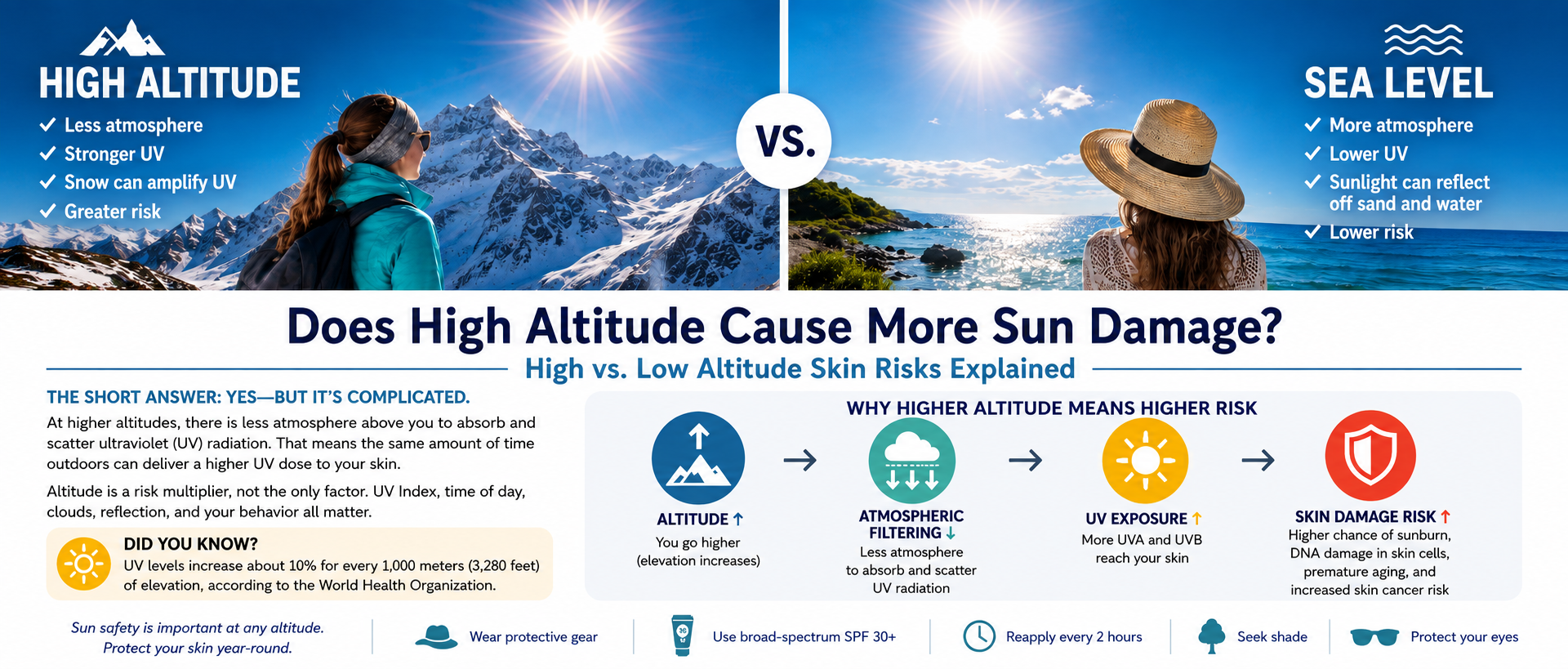
So here is the short answer: yes. Under similar conditions, higher elevation can raise your potential for sun damage more than the same time spent lower down. Altitude works as a UV multiplier. It shares that job with the UV Index, latitude, season, time of day, clouds, reflective surfaces, and how long you stay outside.
Here is what changes as you climb, and what it means for sunburn, early skin aging, and long-term skin health.
Less Atmosphere Means More UV
The air above you works like a filter. It soaks up and scatters part of the sun’s UV before it lands on your skin. Climb higher, and that filter gets thinner. More UV reaches the surface.
The World Health Organization puts the increase at about 10% for every 1,000 meters (3,280 feet) you climb. The U.S. Environmental Protection Agency uses about 6% per kilometer in its UV Index math. Both point the same direction. Real-world measurements land across a range, from roughly 5% to more than 20% per kilometer, shaped by ozone, clouds, aerosols, season, and terrain.
One Alpine study measured the effect cleanly. Under clear summer skies, researchers recorded about a 9% rise in UVA and an 18% rise in burn-causing UV for every 1,000 meters of climb.
No single number captures it. Hold onto the principle instead:
Higher elevation → thinner air filter → more UV → more potential skin damage
High Altitude vs. Low Altitude at a Glance
| Factor | Lower Altitude | Higher Altitude |
|---|---|---|
| Air above you | More | Less |
| UV filtering | Greater | Reduced |
| Potential UV intensity | Lower, all else equal | Higher, all else equal |
| Sunburn potential | Significant | Potentially greater |
| Photoaging exposure | Significant | Potentially greater |
| Snow reflection | Rarely a big factor | Can strongly amplify exposure |
| Temperature as a warning | Unreliable | Especially misleading |
| Sun protection | Daily habit | Daily, with extra care |
Read “all else equal” closely. A sunny afternoon at sea level can still deliver more UV than a short walk on a cloudy peak. Six hours on a Florida beach can hand you far more UV than 30 minutes at 8,000 feet. Altitude raises intensity. Your total dose still depends on time outside and everything else in the table.
UVA and UVB: Two Rays, Two Jobs
Sunlight brings two kinds of UV that matter for skin: UVA and UVB. Both harm skin. They work in different ways.
UVA reaches deeper, down to the layer where collagen and elastin live. Years of it add up to the look most people call aging:
- fine lines and wrinkles
- loss of firmness
- uneven tone and dark spots
- rough or leathery texture
Here is the part many people miss: sun damage does not always show up as a burn. You can bank years of UVA damage without ever turning red.
UVB stays mostly in the top layer and drives sunburn. It also damages the DNA inside skin cells. Your body repairs most of that damage every day. Repeated UV exposure creates repeated chances for a repair to slip. Over time, those errors can add up and raise skin cancer risk.
Sun protection does two jobs at once. It guards against today’s burn. It also lowers the total UV your skin banks over a lifetime.
The Canadian Dermatology Association and the Skin Cancer Foundation link the sun to up to 90% of visible skin aging. That single number makes daily protection the strongest anti-aging step you can take.
The Mountain Factor Many People Miss: Snow
Elevation raises UV on its own. Add snow, and the math shifts again.
Different surfaces bounce back very different amounts of UV. Grass and water send back less than 10%. Sand throws up about 15%. Fresh snow reflects up to about 80%. WHO notes fresh snow can almost double your exposure. UV then hits you twice: straight down from the sky and back up off the ground.
Ski, snowboard, climb, or hike in winter, and you stack several risks together:
Higher elevation + direct UV + snow glare + hours outside = a much larger UV dose
Your face feels cold. Your skin can still soak up heavy UV. The American Academy of Dermatology flags extra caution near snow, sand, and water, since each one reflects rays and raises burn risk.
Cold Weather, Strong Rays
Heat and UV are not the same thing. The warmth you feel comes mostly from infrared. The burning and the aging come from UV. So you can pick up real UV while you:
- ski below freezing
- hike a cool morning trail
- stand in snow
- face a sharp, cold wind
- move around under thin clouds
Clouds can cut UV, sometimes a lot. They still let plenty through. A gray sky calls for protection just the same. Check the UV Index to read the real strength. Warmth tells you about temperature. The UV Index tells you about the rays that age and burn skin.
Does High Altitude Age Your Skin Faster?
Altitude by itself does not age skin. The extra UV it lets through is what adds up. Live, work, or play up high with unprotected skin, and that extra UV piles onto your lifetime total. Over years, it shows up as collagen loss, wrinkles, dark spots, and slack skin.
That makes steady protection a priority for anyone who spends real time up high:
- hiking
- skiing and snowboarding
- climbing
- trail running
- cycling
- outdoor work
- mountain travel
Serums, moisturizers, and retinol each earn a place in an anti-aging routine. None of them replaces sun protection. Guarding your skin today beats trying to undo years of damage later.
Does High Altitude Raise Skin Cancer Risk?
UV is a known cause of skin cancer, so serious protection makes sense at elevation. Notice the gap between two statements. “Altitude can raise UV exposure” rests on solid ground. “Living at a certain altitude raises my personal cancer risk by a set percentage” is far harder to pin down.
Your personal risk rests on many things:
- lifetime UV total
- sunburn history
- skin tone and how easily you burn
- age, genetics, and family history
- number and type of moles
- outdoor work and hobbies
- tanning-bed use
- daily protection habits
Treat elevation as one input to your UV exposure, and weigh it alongside everything else on this list.

Beach Sun Still Counts
High-altitude risk never means low ground is safe. Near sea level, UV can run very high thanks to:
- low latitude
- summer season
- midday sun
- clear skies
- a high UV Index
- long hours outside
- glare off sand and water
- light clothing
A short mountain hike and a full beach afternoon can flip the outcome. Intensity times time equals your real dose. Location alone does not decide it.
Altitude or UV Index: Which Do You Watch?
For daily choices, watch the UV Index. It reports the expected strength of UV for your spot and time. As it climbs, damage comes faster and protection matters more.
Altitude explains why UV can run strong. The UV Index tells you how strong it runs today. Let the number guide your plan, whether you sit at sea level or stand at 10,000 feet.
How to Protect Your Skin Up High
Keep your usual routine for the mountains. Just tighten your discipline on protection.
- Choose broad-spectrum SPF 30 or higher. Broad-spectrum guards against both UVA and UVB. The AAD backs a broad-spectrum, water-resistant sunscreen at SPF 30 or above. SPF 30 blocks about 97% of UVB rays.
- Apply plenty. Most adults need about a shot glass for the body. Cover the easy-to-miss spots: ears, neck, hairline, scalp, hands, the skin around your eyes, and your lips.
- Reapply on long days. Refresh about every two hours, and after sweating or swimming.
- Layer your defense. Add a wide-brim hat, UV sunglasses, long sleeves, UPF clothing, and shade when you can get it.
- Respect the snow. On the slopes, protect against direct and reflected UV. Cover your face, lips, ears, neck, and any bare skin.
- Check the UV Index first. Make it a habit before long stretches outside, at 10,000 feet or at sea level.
Quick Answers
Is the sun stronger higher up? For UV, yes. Less air means less filtering, so UV levels climb as you rise.
How much does UV rise with altitude? WHO puts it near 10% for every 1,000 meters (3,280 feet). The real number shifts with weather and conditions.
Can you sunburn while skiing? Yes. Thin air and snow glare raise UV, and cold does nothing to stop a burn.
Can you get sun damage without a burn? Yes. Photoaging builds up long before, and often without, any redness.
Is SPF 30 enough up high? SPF 30 broad-spectrum is a solid floor. Application, reapplication, clothing, sunglasses, shade, and shorter exposure carry the rest.
Is mountain sun worse than beach sun? Not always. Elevation lifts intensity, and time, latitude, season, and glare shape the final dose. Both can hit hard.
The Bottom Line
Yes, higher altitude can raise your UV exposure. Less air sits above you to filter the rays, so more reach your skin. Snow can push that higher through reflection. Cold air can fool you, since UV does not need heat to harm skin.
Altitude is one piece. The UV Index, latitude, season, time of day, clouds, reflection, hours outside, clothing, and sunscreen all shape your real exposure.
| SUN-SMART TAKEAWAY Higher elevation → thinner air filter → more UV → more potential skin damage Your skin keeps a running tally of UV, even on days you never burn. Daily broad-spectrum sunscreen, smart clothing, sunglasses, shade, and a glance at the UV Index protect you now and cut the buildup that could lead to early aging and skin cancer later. |
This article shares general education. It does not replace advice from a dermatologist or other qualified healthcare professional.