Walk down any skincare aisle and two words jump off the labels: hyaluronic acid and collagen. Hyaluronic acid serums promise deep hydration and a plump, smooth look. Collagen creams promise firmer, younger-looking skin.
They sound like they do the same job. They do not. If you have ever bought a collagen cream hoping it would rebuild what the years took away, the next few minutes will clear things up and save you money. Once you see the difference, choosing the right product for your skin gets much easier.
Here is the one idea that clears up the confusion:
Making skin look plumper on the surface is a different job from rebuilding the collagen your skin loses with age.
Hyaluronic acid hydrates and gives a soft, plump look. A collagen cream can moisturize and smooth. Collagen painted on your face does not travel deep and replace the collagen you have lost. Keep that one point in mind and the whole comparison snaps into focus.
Why Aging Skin Loses Its Plumpness
Young-looking skin does not come from a single ingredient. Its bounce comes from several parts working together:
- Collagen, the structural framework
- Elastin, the “snap-back” fibers
- Hyaluronic acid, the built-in water magnet
- Skin lipids and a healthy barrier
- Water content
Time and sun exposure wear these down. You start to see fine lines, dryness, less firmness, rougher texture and a loss of that full, springy feel. Hydration and collagen loss are two separate problems. You can hydrate skin and make it look plumper today without touching the collagen framework. And supporting collagen over months still leaves you needing daily moisture. That split is the heart of this whole question.
What Hyaluronic Acid Actually Does
The word “acid” throws people off. Hyaluronic acid does not exfoliate like glycolic or salicylic acid. It is a water-loving molecule your body already makes, and it can hold more than 1,000 times its weight in water.
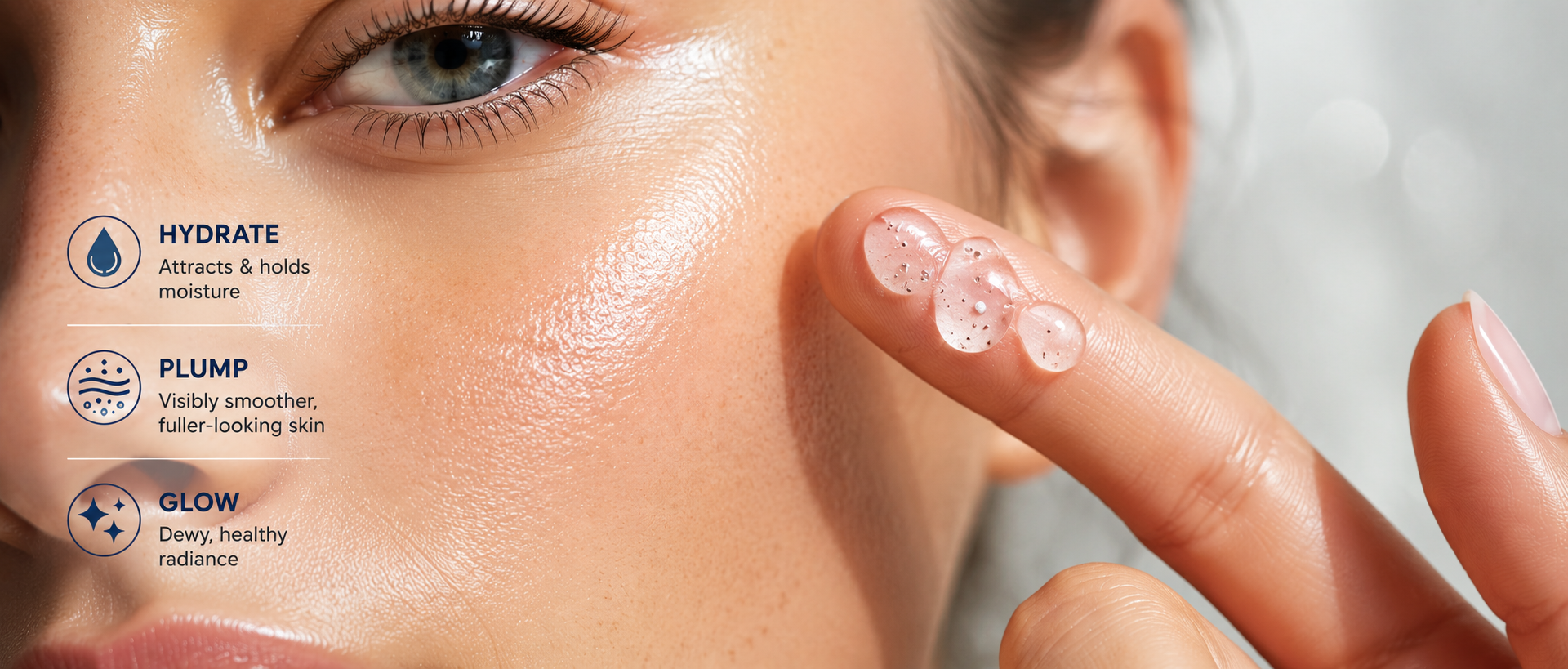
In a well-made product, hyaluronic acid works as a humectant. It pulls water into the top layers of skin and helps hold it there. When those layers hold more water, skin looks smoother, softer and fuller, and fine dehydration lines fade back.
The clinical numbers back this up. In a 2021 study of 40 women with sun-aged skin, a twice-daily hyaluronic acid serum raised measured skin hydration by 134% right after applying, with a 55% increase still holding at six weeks. At six weeks the same study reported gains in plumping (60%), smoothness (64%), hydration (63%), fine lines (31%) and wrinkles (14%). Those figures come from one specific formula, so treat them as a strong example rather than a promise for every serum. They do show why hyaluronic acid earned its plumping reputation.
Plumping Yes, Filler No
Here is the fine print. A topical hyaluronic acid serum and an injectable hyaluronic acid filler are two very different things.
A serum hydrates the surface and gives a temporary, visible plumping. An injectable filler is placed under the skin by a medical professional to restore volume. A serum cannot do what a filler does. So the honest way to describe hyaluronic acid is simple: it boosts hydration, and that hydration makes fine lines look softer and skin look fuller for the day.
Does Hyaluronic Acid Reach Deeper Skin?
Not all hyaluronic acid behaves the same, and molecular weight is the reason. Larger molecules stay near the surface and form a soft, hydrating film. Smaller forms can settle into the upper layers. That is why you see labels calling out high-molecular-weight HA, low-molecular-weight HA, sodium hyaluronate and hydrolyzed hyaluronic acid.
The Mary Kay Clinical Solutions® HA + Ceramide Hydrator is an example of this dual approach. It hydrates on two levels: a low-molecular-weight hyaluronic acid reaches into the outer layer to plump from within, while a high-molecular-weight form sits on the surface to protect and plump from the outside. A skin-mimicking ceramide then supports the barrier so the water you draw in stays put. The Clinical Solutions® line was reviewed and validated by an external panel of U.S. board-certified dermatologists.
One honest caution holds for every brand: more penetration still does not mean a serum can restore lost facial volume, so give big “deep penetration” claims a careful read.
What Collagen Does, and What a Collagen Cream Cannot Do
Collagen is one of the main structural proteins in skin. Picture it as the internal scaffolding that gives skin strength, structure and firmness. As you age, and especially as sun damage adds up, collagen breaks down faster than it rebuilds. That shows up as wrinkles and looser skin.
So the pitch behind collagen cream feels obvious: your skin lost collagen, so put collagen back. Skin does not work that way.
Collagen is a very large protein. Most native collagen weighs around 300,000 daltons, and the skin barrier generally blocks molecules larger than about 500 daltons. That makes collagen about 600 times too big to pass through and rejoin the deep collagen network. In plain terms:
Applying collagen does not refill the collagen your skin has lost.
That is the single most useful takeaway in this comparison.
So Why Can a Collagen Cream Still Help?
Because “does not rebuild deep collagen” and “does nothing” are two very different statements.
A well-formulated collagen cream can be a very good moisturizer. The full formula often carries humectants, emollients, barrier-supporting ceramides and occlusives that:
- Raise hydration
- Slow water loss
- Soften rough skin
- Improve how skin feels
- Make fine lines look less noticeable for the day
Dermatologists point out that much of the fast “firming” you feel from creams is really good moisturization. Well-hydrated skin plumps up, and that softens the look of fine lines. So if you use a collagen cream and your skin looks smoother and plumper, that result can be completely real. The credit goes to moisture and a strong formula. The collagen itself did not rebuild your dermis.
The Peptide Wrinkle
There is one more layer worth knowing. Whole collagen, hydrolyzed collagen and signaling peptides are not the same thing. Peptides are short amino-acid chains, and some are studied for their ability to nudge skin’s own collagen-related processes.
The research is promising and worth watching. It is also still settling. A 2026 review of randomized trials found peptides improved hydration and brightness and were well tolerated, while results for elasticity and skin density stayed inconsistent, and the authors called for larger, standardized studies.
The practical move: judge a cream by its whole ingredient list. The single word on the front tells you very little. Many strong anti-aging formulas pair peptides with hyaluronic acid, glycerin, ceramides, niacinamide and antioxidants. Mary Kay’s collagen-supporting products follow this honest path too, using peptides and plant extracts and careful “supports natural collagen” wording rather than promising to replace it.
Quick Comparison
| Goal | Hyaluronic Acid Serum | Collagen Cream |
|---|---|---|
| Boost skin hydration | Excellent | Can be very good, depends on formula |
| Fast visible plumping | Excellent | Good if highly moisturizing |
| Soften dehydration lines | Excellent | Good |
| Slow water loss | Pair with a moisturizer | Often very good |
| Improve softness | Very good | Excellent in a rich cream |
| Replace lost deep collagen | No | No |
| Restore lost facial volume | No | No |
| Best role | Hydration and plumping | Moisturizing and barrier support |
Which One Wins?
For hydration: hyaluronic acid. As a humectant it has the clearest, most direct role when skin feels tight, dull or rough.
For visible plumping: hyaluronic acid, for the hydration kind of plumping. It will not lift sagging skin or permanently fill wrinkles, and it does not need to. Hydration alone makes a real cosmetic difference.
For fine lines and wrinkles: it depends on the line. If dryness is exaggerating shallow lines, hyaluronic acid plus a good moisturizer softens them fast. Deeper wrinkles from years of sun and structural change need more. Retinoids carry the strongest and most consistent evidence for improving sun damage and supporting skin remodeling. A 2026 research review placed retinoids at the top of proven topical anti-aging ingredients, with hydrators and collagen peptides showing less definitive results.
Mary Kay Clinical Solutions® Retinol 0.3 is a targeted retinol for this step. Keep retinol to one product a night, skip it during pregnancy, and follow the product directions.
For rebuilding collagen: neither hyaluronic acid nor an everyday collagen cream is your primary tool. Give retinoids the lead, and give sunscreen its due. Protecting skin from new UV damage guards the collagen you still have. That is why dermatologists put broad-spectrum SPF 30 or higher and a daily moisturizer at the base of any anti-aging routine. SPF 30 blocks about 97% of UVB rays.
The Smarter Question: Use Both
The “hyaluronic acid vs. collagen” fight misses the point for dry, mature skin. A hydrating serum and a moisturizing cream do complementary jobs, so pairing them beats either one alone.
Think of it as two steps:
- Hydrate. A hyaluronic acid product pulls in water so skin looks smoother and plumper.
- Seal. A moisturizing cream helps hold that water and supports the barrier.
That cream can contain collagen. Choose it for what the whole formula does for your skin. The word on the label matters far less than the ingredient list behind it.
Simple Layering
Morning
| Step | Product |
|---|---|
| 1 | Cleanser |
| 2 | Eye cream |
| 3 | Treatment serum (such as vitamin C) |
| 4 | Hyaluronic acid product |
| 5 | Moisturizer |
| 6 | Broad-spectrum SPF 30 or higher |
Evening
| Step | Product |
|---|---|
| 1 | Cleanser |
| 2 | Eye cream |
| 3 | Hyaluronic acid product |
| 4 | Retinol or other treatment |
| 5 | Moisturizer |
Thin products go on before thick ones. Adjust the order to your specific formulas and any retinol directions.
Two Quick Tips
Apply hyaluronic acid to slightly damp skin, then lock it in with moisturizer. The humectant grabs the available water, and the cream keeps it from escaping.
Give it time. Surface hydration and glow can show up fast. Texture and brightness build over 4 to 8 weeks. Changes tied to fine lines and collagen take months, and daily sunscreen protects every bit of that progress.
A Complete Anti-Aging Strategy
- Hydrate. Hyaluronic acid and glycerin draw in water.
- Moisturize and support the barrier. A strong moisturizer slows water loss and keeps the barrier healthy.
- Treat. Match the active to your skin and comfort level: retinoids, vitamin C, niacinamide or peptides.
- Protect. Broad-spectrum SPF 30 or higher every morning, all year.
This beats chasing one miracle ingredient, because each product does one job well.
The Bottom Line
Hyaluronic acid plumps skin by boosting hydration. A collagen cream can moisturize and smooth. Collagen on the surface does not replace the deep collagen you lose with age. Both can earn a place in your routine for different reasons.
So the real skincare lesson is this: judge an ingredient by what it actually does in your skin. How youthful the name sounds on the jar tells you nothing.
Build a routine that fits your skin
Want help building a simple routine around your skin and your goals? Reach out to your Mary Kay Independent Beauty Consultant, and try the hydrate-and-seal steps for a few weeks to see the difference for yourself.
This article is for general education and is not medical advice. For concerns about your specific skin, talk with a board-certified dermatologist.